MagazineCollagen during pregnancy and breastfeeding: can you take it?
Collagen during pregnancy and breastfeeding: can you take it?
Can you take collagen while pregnant or breastfeeding? A short answer, how much protein your body needs now, what to watch out for with marine collagen and why you should always talk to your doctor.

Short answer: yes. Collagen is a protein we routinely eat in broths, gelatine and fish, and we consider pure hydrolysed collagen without other additives fine during pregnancy and breastfeeding. Clinical trials have not yet included pregnant or breastfeeding women, which is why we always recommend talking to your doctor before you start. They know your health and pregnancy calls for individual advice.
Why people ask about collagen in pregnancy
It is one of the questions we get most often, on social media and by email. The body changes, protein needs rise and many women think about their skin, hair and nails. According to the European Food Safety Authority (EFSA), a pregnant woman needs about 1 g of protein a day on top of the usual recommended intake in the first trimester, 9 g in the second and 28 g in the third. During breastfeeding it is an extra 19 g a day in the first six months and 13 g a day after that (EFSA, 2012).
Collagen cannot cover that need on its own. It lacks the essential amino acid tryptophan, so it counts as an incomplete protein (Paul et al., 2019). A varied diet with meat, fish, eggs, dairy or pulses remains the foundation. A sachet of collagen (3.3 g) adds to it but does not replace it.
What we know about safety, and what we do not
Studies in healthy adults describe collagen safety well. A review of 11 placebo-controlled trials with 805 participants found no reported adverse events (Choi et al., 2019). Pregnant and breastfeeding women were not included, as is usual for food supplements, so direct data for them are missing.
Collagen is not a foreign substance to the body, though. Like other dietary proteins, it is broken down in the gut into amino acids and short peptides, which then appear in the blood (Iwai et al., 2005). It is neither a herb nor a medicine but a protein the body knows from ordinary food. That is why we consider pure collagen fine during pregnancy and breastfeeding and leave the final word to your doctor.
When to be careful
| Situation | Why | What to do |
|---|---|---|
| Fish allergy | Fish collagen is a proven allergen and the reaction is shared across fish species (Hamada et al., 2001). | Do not take marine collagen; discuss another source with an allergist. |
| Mercury and heavy metals from fish | During pregnancy, limiting fish high in mercury is recommended (EFSA, 2015). | Choose a collagen whose manufacturer publishes heavy metal test results. |
| Combination products | Added vitamins, herbs or mushrooms come with their own rules. High doses of vitamin A from supplements are linked to a higher risk of birth defects (Rothman et al., 1995). | Read the ingredients and, for combinations, follow the label and your doctor. |
| Tendency to kidney stones | The body turns part of the hydroxyproline in collagen into oxalate (Knight et al., 2006). | Talk to your doctor and drink plenty of fluids. |
| Pregnancy complications | With gestational diabetes, high blood pressure or kidney disease, your doctor may adjust protein and supplement intake. | Always discuss supplements with the doctor looking after you. |
Stretch marks, skin and hair
Many of you ask whether collagen helps against stretch marks. The honest answer: no studies have tested it in pregnant women. Even for creams and oils against stretch marks, a Cochrane review found no convincing evidence that they prevent them (Brennan et al., 2012). See collagen as part of looking after yourself, not as a promise that stretch marks will not appear.
After giving birth, many women notice more hair shedding. It is usually temporary and linked to hormonal changes. If it is heavy or lasts a long time, see your doctor.
How to take collagen during pregnancy and breastfeeding
- Talk to your doctor first. Bring the pack or the list of ingredients.
- Choose pure collagen. No sweeteners, flavourings, herbs or added vitamins, with test results for heavy metals and microbiology.
- Stick to the recommended dose. For collalloc that is one sachet (3.3 g) a day.
- Dissolve it in a cold or lukewarm drink, at most 60 °C. Water, juice, milk or a smoothie.
- Keep your diet varied. Collagen does not replace protein from food or the vitamins your doctor recommends.
How we handle it at collalloc
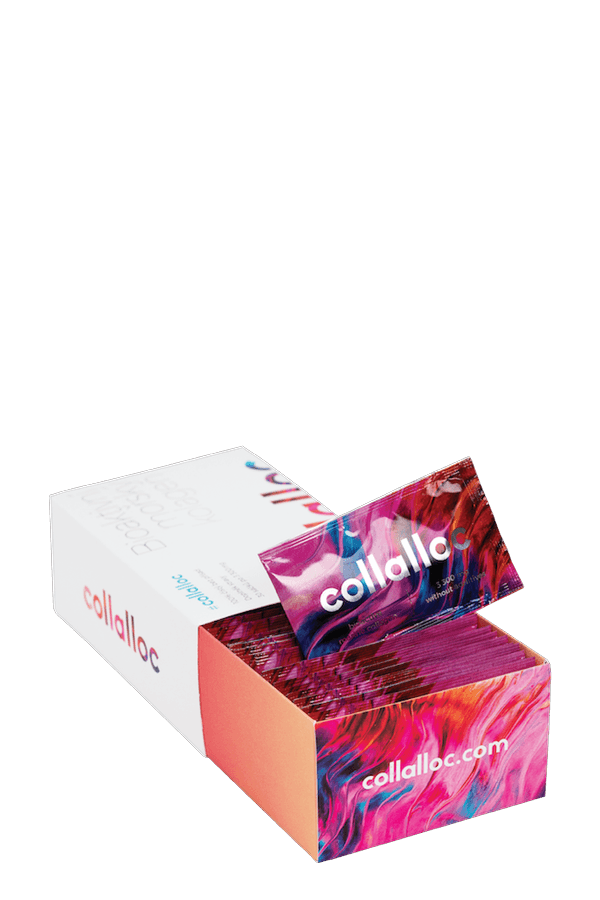
collalloc collagen contains only hydrolysed marine collagen, with no sweeteners, colourings or flavourings. Microbiology is tested for every production batch and heavy metals every month by an external laboratory. You will find the results, including the limits, on the product page and on our Laboratory page, so you can show them to your doctor too. As the collagen comes from fish, it is not suitable if you have a fish allergy.
How to take collagen so that it absorbs well is covered in How to take collagen. Possible risks in general are summed up in Collagen side effects.
Frequently asked questions
Can I take collagen during pregnancy?
We consider pure hydrolysed collagen fine during pregnancy; it is a protein the body also knows from ordinary food. Studies in pregnant women are missing, though, so always talk to your doctor before you start.
Can I take collagen while breastfeeding?
Yes, the same applies as in pregnancy. Collagen is broken down into amino acids and peptides like other dietary proteins. Dedicated studies in breastfeeding women are missing, so talk to your doctor first.
Which collagen should I choose during pregnancy and breastfeeding?
Pure hydrolysed collagen without sweeteners, herbs or added vitamins, with published heavy metal test results. If you are allergic to fish, do not take marine collagen.
Does collagen help against stretch marks?
No studies have tested it in pregnant women. Even for creams against stretch marks, a Cochrane review found no convincing evidence that they prevent them (Brennan et al., 2012).
How much collagen a day during pregnancy?
Stick to the dose on the pack; for collalloc that is one sachet (3.3 g) a day. Collagen does not replace dietary protein, which you need more of during pregnancy and breastfeeding.
Can I add collagen to warm tea?
Lukewarm yes, hot no. The drink should not be hotter than 60 °C; cold water, juice, milk or a smoothie work best.
Sources
- Scientific Opinion on Dietary Reference Values for protein EFSA Panel on Dietetic Products, Nutrition and Allergies (NDA), EFSA Journal, 2012
- Significant Amounts of Functional Collagen Peptides Can Be Incorporated in the Diet While Maintaining Indispensable Amino Acid Balance Paul C., Leser S., Oesser S., Nutrients, 2019
- Oral Collagen Supplementation: A Systematic Review of Dermatological Applications Choi F. D., Sung C. T., Juhasz M. L., Mesinkovsk N. A., Journal of Drugs in Dermatology, 2019
- Identification of food-derived collagen peptides in human blood after oral ingestion of gelatin hydrolysates Iwai K., Hasegawa T., Taguchi Y. et al., Journal of Agricultural and Food Chemistry, 2005
- Identification of collagen as a new fish allergen Hamada Y., Nagashima Y., Shiomi K., Bioscience, Biotechnology, and Biochemistry, 2001
- Statement on the benefits of fish/seafood consumption compared to the risks of methylmercury in fish/seafood EFSA Scientific Committee, EFSA Journal, 2015
- Teratogenicity of high vitamin A intake Rothman K. J., Moore L. L., Singer M. R. et al., New England Journal of Medicine, 1995
- Hydroxyproline ingestion and urinary oxalate and glycolate excretion Knight J., Jiang J., Assimos D. G., Holmes R. P., Kidney International, 2006
- Topical preparations for preventing stretch marks in pregnancy Brennan M., Young G., Devane D., Cochrane Database of Systematic Reviews, 2012